Why Docker changes Software Delivery forever?

In today’s tech driven world, Docker has become a backbone tool for modern devops and Software delivery process. But what is Docker? Why was Docker introduced ? What exactly did docker change? How does it actually resolved issue between developers and operations team? Let’s break it down into simple, clear and understand why it is popular in software industry.
What is Docker?
Docker is a containerization tool. The name itself indicates that it is used to build containers. It is an open-source, centralized platform designed to create, deploy, and run applications across multiple environments. Docker is written in the Go programming language.
The key advantage of Docker is that it uses the host operating system to run applications. This means it allows applications to use the same Linux kernel as the host system, rather than creating an entire virtual operating system for each application.
Docker can be installed on multiple operating systems; however, the Docker Engine runs natively on Linux distributions. Docker performs OS-level virtualization, which enables lightweight, fast, and efficient application deployment.
Why was docker introduced?
For years, software delivery had one invisible enemy — the environment.
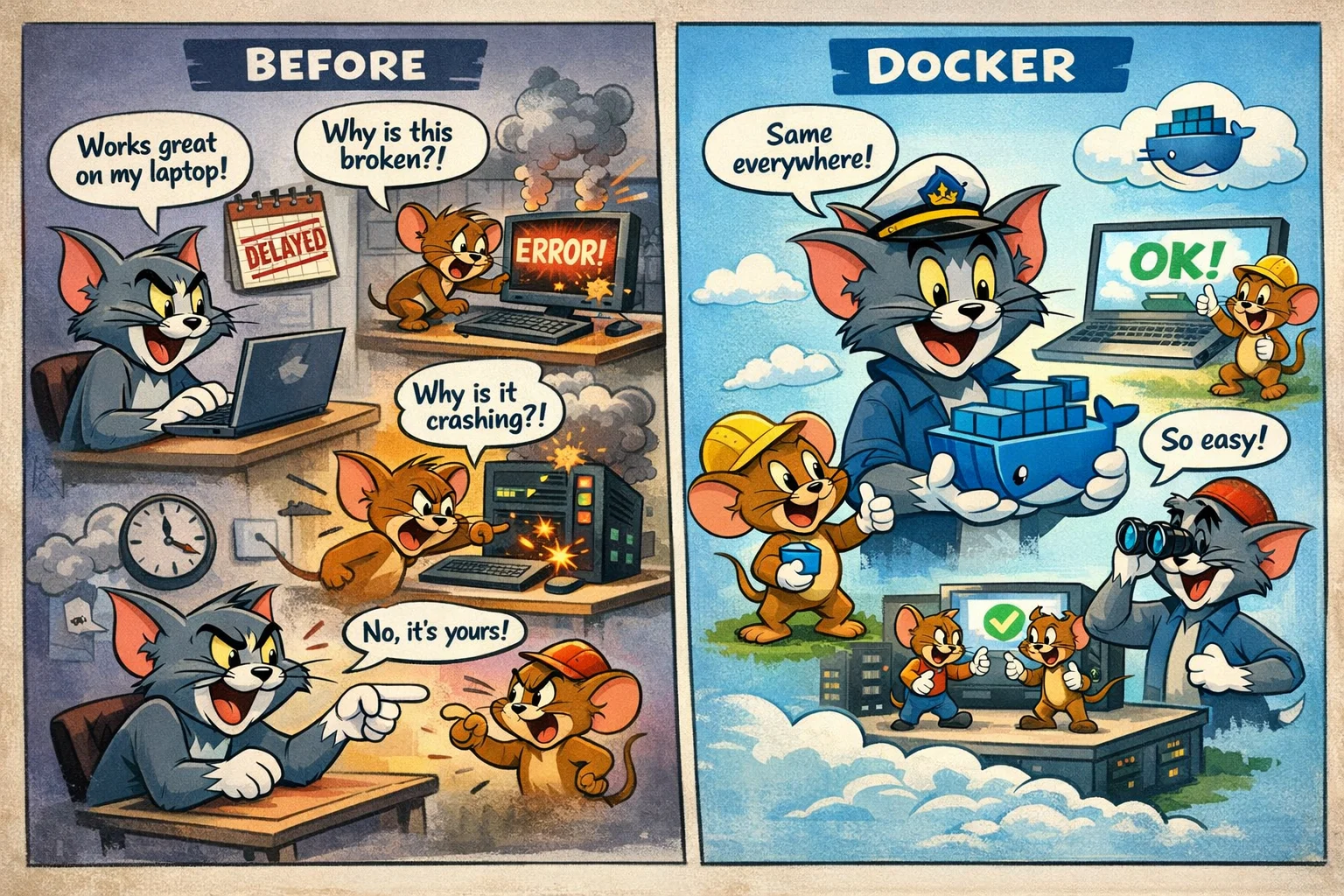
Before Docker was introduced, many teams faced a common problem: the same code that ran successfully on a developer’s system failed during testing and behaved unpredictably in production. These issues were difficult to debug and often took hours or even days to resolve. As a result, code deployments to production were delayed, and developers and operations teams frequently blamed each other while trying to identify the root cause.
Virtual Machines provided a partial solution, but they rely on hardware-level virtualization. Each virtual machine requires a complete operating system, which consumes significant hardware resources such as RAM and CPU. This approach lacked efficiency and resulted in long startup times.
This all changed with Docker. Since Docker uses OS-level virtualization, it ensures consistency across all environments while offering better scalability and higher efficiency.
What exactly did docker change to resolve issue between developers and operations team?
Docker introduced images and containers to run applications consistently across multiple environments.
A Docker image is a read-only template that contains a set of instructions used to create a container that can run on the Docker platform.
A Docker container is a lightweight, standalone, and executable software package that encapsulates an application along with all its required dependencies, such as libraries and runtime environments. Containers created from a Docker image can run on any machine that has Docker installed, ensuring consistency and portability across environments.
Docker Registry is a repository for storing and sharing the docker images. In registry we can store our images in public or private.
Conclusion:
Docker addressed one of the most persistent challenges in software delivery—environment inconsistency—by introducing a standardized way to package and run applications using containers. Through Docker images, containers, and registries, applications can be built once and executed reliably across development, testing, and production environments. By eliminating dependency conflicts and reducing infrastructure overhead, Docker streamlined collaboration between development and operations teams, reduced deployment delays, and improved delivery efficiency. Today, Docker stands as a foundational technology in modern DevOps, enabling scalable, portable, and reliable software delivery across the software industry.
What’s Next in This Series?
Upcoming blogs:
Docker Architecture Explained
Docker Images vs Containers
Dockerfile Explained Line by Line
